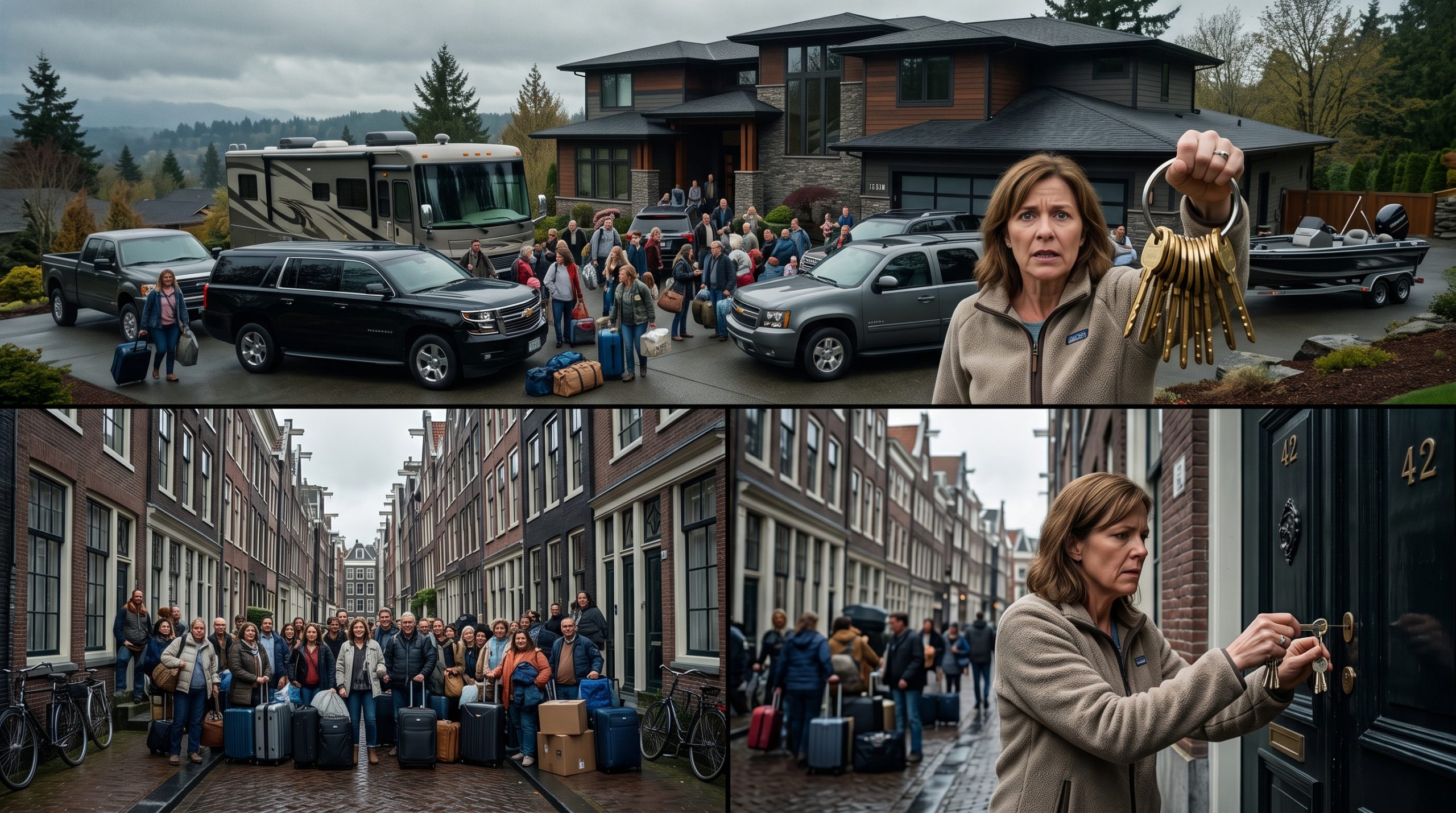
My Mother Gave My House Keys to Twenty Relatives. She Didn’t Know I Had Changed the Locks Months Earlier.
PART 1
I found out my mother had handed out copies of my house keys the same way I discovered most things in my family.
Someone thanked me for something I had never agreed to.
It happened on a Wednesday afternoon in early June.
I had just finished a twelve-hour day at my architecture firm in Seattle and was standing in line at a grocery store trying to decide whether I had enough energy left to cook dinner.
My phone buzzed.
A text from my cousin, Hannah.
Hannah: You’re seriously the best.
Me: For what?
Hannah: Letting everyone stay at your house for Grandma’s birthday weekend.
I stared at the message.
Then read it again.
Everyone.
Stay.
My house.
Grandma’s birthday weekend.
Interesting.
Because my grandmother’s birthday wasn’t for another three weeks.
And I certainly had not volunteered to host twenty people.
Me: What are you talking about?
Three dots appeared.
Stopped.
Appeared again.
Hannah: Wait.
Hannah: Aunt Carol didn’t tell you?
I already knew.
Whenever someone asked if my mother had told me something, the answer was almost always no.
A screenshot arrived.
Family group chat.
Mom: No need for hotels! Emily’s house has plenty of room.
Mom: I already gave everyone keys.
Mom: Come and go whenever you want.
Mom: Family should never pay for accommodations.
Twenty-seven heart emojis followed.
Then confirmations.
We’ll be there Friday!
Bringing the kids!
Can’t wait!
See everyone soon!
One aunt asked whether pets were allowed.
Another asked if someone could arrive Thursday night instead.
My uncle announced he planned to bring his boat.
His boat.
To my suburban neighborhood.
I rubbed my forehead.
For a moment, I honestly thought I was reading a joke.
Then I remembered who my mother was.
Carol Bennett.
Professional volunteer of other people’s time.
Expert distributor of other people’s resources.
Lifelong believer that family access required no permission.
At sixteen, she loaned out my car while I was at school.
At twenty-four, she offered my apartment to visiting relatives while I was away on business.
At thirty-one, she promised my guest room to a cousin for six weeks without asking.
Every incident ended the same way.
Family helps family.
Don’t be dramatic.
It’s only temporary.
You’re making people uncomfortable.
Eventually, I learned something.
People who repeatedly cross boundaries rarely see boundaries as protection.
They see them as rejection.
And my mother hated rejection.
Especially when it came from me.
I called her immediately.
She answered cheerfully.
“Hi sweetheart.”
“Mom.”
“How are you?”
“Why are twenty relatives planning to stay in my house?”
Silence.
Tiny.
Brief.
Then laughter.
“Oh.”
“Grandma’s birthday.”
“Yes.”
“What about it?”
“You offered my house.”
“I offered family comfort.”
“You offered my house.”
“Same thing.”
“No.”
She sighed.
Already annoyed.
“You have four bedrooms.”
“I have four bedrooms because I live there.”
“Everyone is excited.”
“Everyone should probably be less excited.”
Mom laughed again.
The kind of laugh people use when they believe resistance is temporary.
“Oh honey.”
“It’s only one weekend.”
“Twenty relatives.”
“It’s family.”
“It’s twenty people.”
“They’ll spread out.”
“Inside my house.”
She paused.
Then said something that explained everything.
“I already gave everyone keys.”
I blinked.
“What?”
“Copies.”
“Copies of what?”
“Your house keys.”
My grip tightened around the shopping cart handle.
“Mom.”
“What?”
“Where did you get copies?”
“You gave me an emergency key years ago.”
Emergency.
Interesting.
Emergency apparently meant birthdays now.
Vacations.
Family reunions.
Casual occupancy.
I closed my eyes.
Because two years earlier, after a pipe burst during a winter storm, I had given Mom a spare key.
Just in case.
Just in case something happened.
Just in case I was traveling.
Just in case there was actual urgency.
Apparently my mother had interpreted “emergency access” as “community property.”
“How many copies?”
She sounded proud.
“Twenty.”
Twenty.
Not two.
Not three.
Twenty.
My house had become a timeshare.
Without my knowledge.
Without my consent.
Without a single conversation.
“When exactly were you planning to tell me?”
“I assumed you’d be happy.”
Assumed.
There it was.
One of my family’s favorite words.
Assumed.
People assume a lot when they never expect consequences.
Dad joined the call.
Of course he did.
Conference calls were one of my parents’ favorite tactics.
Two voices create pressure.
Pressure creates compliance.
At least it used to.
“Emily,” Dad said.
“Your grandmother deserves one nice weekend.”
“My grandmother deserves a wonderful weekend.”
“So?”
“So she doesn’t deserve access to my house without permission.”
Dad sighed dramatically.
“You’re always making everything about ownership.”
I looked out toward the parking lot.
People pushed carts.
Loaded groceries.
Lived ordinary lives.
Meanwhile, twenty people apparently possessed keys to my home.
“I make ownership about ownership because I own the house.”
“It’s family property.”
“No.”
“It’s where family gathers.”
“It is where I sleep.”
Mom interrupted.
“Everyone already has travel plans.”
“I didn’t make those plans.”
“People took time off.”
“I didn’t ask them to.”
“We’ve promised everyone.”
I almost laughed.
Promised.
Interesting.
Because people can promise things they don’t own remarkably easily.
“Mom.”
“What?”
“Do you still have your copy?”
“Of course.”
“Interesting.”
She paused.
“What does that mean?”
I smiled.
For the first time during the entire conversation.
Because six months earlier, something had happened.
Nothing dramatic.
No betrayal.
No fight.
Just accumulation.
Years of assumptions.
Years of access.
Years of being treated like the family resource center.
Eventually, I had reached a conclusion.
Peace is easier to protect than reclaim.
So six months ago—
I changed every lock in the house.
Front door.
Back door.
Garage entry.
Side gate.
Everything.
New keys.
New codes.
New access.
I never told my mother.
Because emergency keys belong to people who understand emergencies.
Not people who make twenty copies.
Mom spoke again.
“Emily?”
“Yes?”
“Why do you sound so calm?”
I set my groceries onto the conveyor belt.
Paid for them.
Picked up my bags.
Then answered.
“Because I changed the locks six months ago.”
Silence.
Complete silence.
Dad spoke first.
“You what?”
“I changed the locks.”
Mom laughed nervously.
“Stop joking.”
“I’m not joking.”
“Our keys work.”
“No.”
“They absolutely work.”
“No.”
“I literally tested mine last year.”
“And I changed the locks six months ago.”
Another silence.
Longer.
Heavier.
Then Mom said something that told me exactly how much trouble was about to arrive.
“You changed the locks and didn’t tell me?”
I started walking toward my car.
“Mom.”
“What?”
“You gave twenty relatives keys to a house they can’t enter.”
And for the first time—
My mother sounded worried.
END OF PART 1
PART 2
For several seconds, nobody spoke.
Then my mother laughed.
Not confidently.
Not dismissively.
Nervously.
The kind of laugh people use when reality begins colliding with assumptions.
“Emily.”
“Yes?”
“You wouldn’t actually do that.”
“I already did.”
Dad exhaled loudly.
“Why would you change the locks?”
“Because people kept treating my house like a hotel.”
“We’re your parents.”
“And I’m your daughter.”
“So?”
“So being related doesn’t automatically create access.”
Mom sounded offended.
“I’ve never abused access.”
I almost smiled.
Because people rarely define abuse the same way as the people experiencing it.
At twenty-six, I returned from a business trip to discover my cousin staying in my guest room.
Mom had called it helping family.
At thirty-two, my uncle used my garage to store furniture for three months.
Mom called it temporary.
At thirty-five, two relatives spent Thanksgiving week inside my house while I was working in Chicago.
Mom called it practical.
Every incident had something in common.
Nobody asked.
Everyone informed.
And apparently informing someone had become the family equivalent of permission.
“Mom.”
“What?”
“Do you remember Aunt Denise staying in my house while I was in New York?”
“She needed a place.”
“Do you remember Uncle Robert storing a fishing boat in my driveway?”
“It was convenient.”
“Do you remember Cousin Jenny borrowing my car?”
“She returned it.”
I paused.
“Exactly.”
Dad groaned.
“You’re bringing up ancient history.”
“No.”
“I’m explaining why I changed the locks.”
Mom became quiet.
Because explanations become uncomfortable when they contain examples.
“We’re family,” she finally said.
“Yes.”
“Family shares.”
“Family asks.”
Silence.
Then she said the thing I already knew she was thinking.
“You don’t trust us.”
Interesting.
Because people who repeatedly ignore boundaries often interpret boundaries as evidence of distrust.
When sometimes boundaries are simply evidence of experience.
“I trust you to be exactly who you’ve always been.”
She inhaled sharply.
“That’s cruel.”
“No.”
“It’s honest.”
Dad jumped back in.
“So what are we supposed to do now?”
I checked the family chat.
One hundred and forty-three unread messages.
Apparently excitement had reached peak levels.
People discussed sleeping arrangements.
Food.
Games.
Parking.
One uncle asked if anyone wanted to organize a karaoke night.
Inside my house.
A house nobody had permission to use.
“How many people are coming exactly?” I asked.
Mom hesitated.
“Twenty.”
“Dad said twenty.”
“Twenty-two.”
“Earlier it was twenty.”
“Well…”
She paused.
“Some people invited friends.”
I stopped walking.
“What?”
“Just a few.”
“How many?”
“Maybe twenty-six.”
I laughed.
Actually laughed.
Because once people assume access exists, they become remarkably generous with invitations.
Apparently we had progressed from relatives to guests of relatives.
By tomorrow, strangers might be attending.
“Mom.”
“What?”
“Do these people know I never agreed?”
Silence.
Again.
Interesting.
Because silence often answers questions better than words.
“Mom.”
“What did you tell them?”
“I said you were happy to host.”
I nodded slowly.
There it was.
The real issue.
Not keys.
Not locks.
Not birthday celebrations.
A story.
My mother had created a version of me that existed for other people’s convenience.
Generous Emily.
Reliable Emily.
Helpful Emily.
The daughter who always said yes.
The daughter who never objected.
The daughter who absorbed inconvenience so everyone else could remain comfortable.
The problem was—
That version of me no longer existed.
I opened the family group chat.
Then typed.
Me: Just to clarify.
Me: I was never asked about hosting Grandma’s birthday weekend.
Me: I never offered my house.
Me: I never approved overnight guests.
Me: I did not know house keys had been copied and distributed.
Me: The locks were changed six months ago.
Me: No existing keys work.
Silence.
Complete silence.
Then messages exploded.
Aunt Denise: Wait WHAT?
Uncle Robert: Carol said this was your idea.
Cousin Hannah: Oh no.
Cousin Jenny: I already booked flights.
Uncle Steve: We rented an RV.
Aunt Linda: We thought Emily invited everyone.
Mom immediately replied.
Mom: There’s been a misunderstanding.
Interesting.
Because misunderstandings usually involve communication.
This involved assumptions.
Assumptions presented as facts.
Dad sent a message.
Dad: Family matters should stay private.
I answered.
Me: Family matters became public when twenty-six people received keys to my house.
No response.
For several minutes.
Then Grandma herself entered the conversation.
Grandma: Emily wasn’t asked?
Grandma: Carol?
Grandma: Is this true?
My mother didn’t answer immediately.
That alone was telling.
Because my grandmother had always been the one person Mom struggled to manipulate.
Grandma believed in something radical.
Permission.
Eventually Mom replied.
Mom: We thought she’d be okay with it.
Grandma answered immediately.
Grandma: Thinking is not asking.
I smiled.
Because at eighty-two years old—
Grandma still understood boundaries better than half the family.
That evening, my phone rang.
Grandma.
I answered immediately.
“Hi Grandma.”
“Oh sweetheart.”
“You okay?”
“I am.”
“I had no idea.”
“I know.”
She sighed.
“I told your mother years ago that generosity only counts when the person giving actually agrees.”
I laughed softly.
“Apparently she forgot.”
“No.”
Grandma paused.
“She remembered.”
“Then why?”
“Because people become accustomed to access.”
That landed.
Because it was true.
At first, people appreciate kindness.
Eventually—
Some people start budgeting around it.
Planning around it.
Expecting it.
Then becoming upset when it disappears.
Grandma laughed quietly.
“Although I have to admit.”
“What?”
“The locks changing six months ago is rather poetic.”
I smiled.
“I thought so too.”
PART 3
By Friday, the entire family knew.
Not everyone was angry.
Most were embarrassed.
Because most people genuinely believed my mother had permission.
Several apologized.
Some privately.
Some publicly.
Aunt Denise called.
“I’m sorry.”
“It’s okay.”
“We should have asked.”
“Yes.”
“We just believed your mom.”
“I know.”
Uncle Robert apologized too.
Even Cousin Hannah admitted something.
“I honestly thought you offered because you loved hosting.”
Interesting.
Because people often confuse politeness with preference.
Just because someone accommodates others doesn’t mean they enjoy it.
Sometimes they’re simply avoiding conflict.
For years—
That had been me.
Avoiding conflict.
Avoiding discomfort.
Avoiding accusations of selfishness.
Until I realized something.
Peace maintained through self-sacrifice eventually stops feeling peaceful.
It starts feeling expensive.
Mom called three days later.
Her voice sounded smaller.
Less certain.
“Emily.”
“Yes?”
“People are upset.”
“I imagine they are.”
“They think I lied.”
I remained quiet.
Because sometimes silence creates room for honesty.
Finally she sighed.
“I didn’t think it was a big deal.”
“Giving away copies of someone’s house keys isn’t a big deal?”
“I just wanted everyone together.”
“You wanted everyone together in my house.”
“It’s big enough.”
“It’s mine.”
She became emotional.
“You’ve changed.”
There it was.
The sentence every family caretaker eventually hears.
You’ve changed.
As though growth itself is betrayal.
As though boundaries equal rejection.
As though saying no means becoming someone else.
Maybe it does.
Maybe that’s not a bad thing.
“Yes,” I said.
“I have.”
“I don’t know who taught you to be this hard.”
I looked around my living room.
My books.
My furniture.
My quiet.
My life.
Then answered honestly.
“You did.”
Silence.
Longer this time.
Because years of entitlement often teach people how to protect themselves.
Even if that lesson wasn’t intentional.
Grandma’s birthday eventually happened.
At a rented event center.
People contributed money.
Reservations were made.
Guests had hotel rooms.
Plans existed.
Permission existed.
And remarkably—
Everyone still had a wonderful time.
Grandma hugged me before I left.
“You know.”
“What?”
“Your mother still thinks this is about locks.”
I smiled.
“It’s not.”
“I know.”
“It’s about respect.”
Grandma nodded.
“Exactly.”
Months passed.
Family dynamics changed.
People started asking.
Can we visit?
Can we stop by?
Can we stay over?
Simple questions.
Normal questions.
Healthy questions.
My mother struggled with it at first.
Habits built over decades rarely disappear overnight.
But eventually—
She adapted.
Slowly.
Awkwardly.
Imperfectly.
But genuinely.
One Sunday afternoon, almost a year later, Mom visited.
She stood at my front door holding cookies.
Store-bought.
She never baked.
She smiled nervously.
“I know this sounds silly.”
“What?”
“Can I come in?”
I looked at her.
Really looked.
At the woman who had spent years assuming access.
The woman who believed motherhood and permission were interchangeable.
The woman who had handed out twenty copies of a key she no longer possessed.
Then I smiled.
“Of course.”
She stepped inside.
Slowly.
Respectfully.
Like someone entering a place they finally understood wasn’t automatically theirs.
Progress rarely looks dramatic.
Sometimes—
It looks like someone finally knocking instead of walking in.
For most of my life, silence felt uncomfortable.
Like guilt.
Like disappointment.
Like punishment.
Now—
Silence felt different.
It felt safe.
It felt protected.
It felt earned.
And for the first time in years—
My home wasn’t a family resource.
It wasn’t an obligation.
It wasn’t an expectation.
It was simply mine.
And that was enough.
THE END