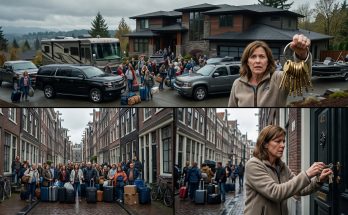
They Moved Into My Beach House While I Was Working Night Shifts. They Forgot I Owned Every Key.
## PART 1
I had just finished my fourth night shift in five days when my phone started vibrating against the passenger seat.
It was six thirty in the morning.
Seattle was waking up around me. Rain clung to the windshield in thin streaks, commuters filled the highway, and my scrubs smelled like antiseptic, stale coffee, and exhaustion.
At Harborview Medical Center, nights had a way of stretching time.
People coded.
Families cried.
Monitors screamed.
And somewhere between three in the morning and sunrise, everyone started looking equally fragile.
By the time I pulled into my apartment parking lot, my feet ached, my head pounded, and all I wanted was eight uninterrupted hours of sleep.
My phone buzzed again.
Family group chat.
Forty-two unread messages.
I sighed.
Nothing good ever came from forty-two messages before seven in the morning.
I opened the conversation.
Mom: Everyone is excited!
Dad: We should get there around noon.
Kyle: Who’s bringing steaks? 😂
Aunt Cheryl: Can’t wait to see the beach again!
Uncle Mark: Kids already packed their swimsuits.
I frowned.
Beach?
Then I kept scrolling.
Mom: Emma, make sure the guest rooms are clean.
Dad: We invited the Johnsons too.
Kyle: Twenty people total.
Mom: Fill the fridge before you come down.
Dad: Family time matters.
For a moment, I thought I was reading someone else’s conversation.
Then my stomach dropped.
My beach house.
They were talking about my beach house.
The one I bought three years earlier after nearly a decade of overtime.
The one near Cannon Beach.
The one I paid for entirely myself.
The one I escaped to whenever hospital life became too loud.
The one place that belonged only to me.
I stared at the screen.
Twenty people.
No one had asked.
No one had called.
No one had even pretended to ask permission.
They had simply decided.
Because that was what my parents did.
They treated boundaries like suggestions.
Growing up, privacy was something other people had.
My mother read my journals.
My father opened my mail.
Kyle borrowed my car without asking and returned it with an empty gas tank.
Whenever I complained, Mom would smile.
“Families share.”
Whenever I protested, Dad would shrug.
“Don’t be selfish.”
And somehow, selfish always meant refusing to surrender something I had worked for.
At twenty-two, it was my savings account.
At twenty-six, it was my spare bedroom.
At thirty-three, apparently, it was an entire house.
I typed a response.
Me: No.
Three dots appeared instantly.
Mom: Excuse me?
Me: No one has permission to use my beach house this weekend.
Dad: Don’t start this.
Mom: Everyone already made plans.
Kyle: Seriously? Over a house?
Me: Over my house.
Mom answered with a laughing emoji.
Then another.
Then another.
Mom: You’re exhausted from work.
Dad: Stop being dramatic.
Mom: Your cousins are already driving.
Dad: Family shouldn’t need permission.
I stared at those words.
Family shouldn’t need permission.
Funny.
Because family had needed money before.
Family had needed favors.
Family had needed babysitters.
Family had needed emergency loans.
And somehow, family always seemed to need me.
But no one ever seemed to ask what I needed.
I got out of the car and climbed the stairs to my apartment.
Rain drummed softly against the windows.
My phone rang.
Dad.
I declined.
It rang again.
Declined.
Again.
Declined.
Then came the voicemail.
I didn’t need to listen.
I knew the tone.
Disappointment disguised as authority.
Love disguised as obligation.
Control disguised as concern.
I tossed my phone onto the couch and headed for the shower.
Hot water helped.
It always did.
Hospitals taught you strange coping mechanisms.
Coffee.
Silence.
Long showers.
Small routines.
Things that reminded you life still belonged to you.
Afterward, I made tea and sat at the kitchen table.
Then I opened my laptop.
Because I had learned something important over the years.
People who ignore boundaries rarely stop because you explain yourself better.
They stop when boundaries become inconvenient.
My beach house had a smart security system.
I opened the app.
Current door code:
CARTER24
I almost laughed.
My mother had convinced me to create a shared family code the previous summer.
“Just in case someone needs access.”
At the time, I had wanted to believe things were changing.
That family could become healthier.
That people could learn.
Apparently not.
I deleted the code.
Created a new one.
Changed every lock setting.
Disabled guest access.
Removed old permissions.
Revoked remote garage entry.
Updated camera notifications.
Then I called my neighbor.
Mrs. Whitmore answered on the second ring.
“Emma?”
“Hi, Barbara.”
“You sound tired.”
“I am.”
“You nurses never sleep.”
I smiled.
“We try.”
“What happened?”
“My family.”
She sighed immediately.
“Ah.”
That single sound carried years of understanding.
Mrs. Whitmore had lived across from my beach house for nearly twenty years.
She knew everyone.
She noticed everything.
And she had watched my parents arrive uninvited enough times to recognize a pattern.
“They’re coming again?” she asked.
“Twenty people.”
“Oh dear.”
“They don’t have permission.”
“They never do.”
“I changed the codes.”
“Good.”
“If they show up, can you keep an eye on things?”
Mrs. Whitmore snorted.
“Honey, I’ll have my binoculars ready.”
I laughed despite myself.
“I appreciate you.”
“You’re too kind.”
“No,” she said. “You’re too patient.”
That lingered.
Because patience and permission were not the same thing.
And somewhere over the years, I had mistaken one for the other.
After hanging up, I made another call.
The locksmith.
He had worked on the property before.
Last summer.
After Dad had borrowed an emergency key.
Without asking.
And hosted a barbecue.
For fifteen people.
I had spent my next weekend cleaning beer bottles out of flowerbeds.
Scrubbing grease from the deck.
Replacing broken patio lights.
Mom had called me sensitive.
Dad had called me ungrateful.
Kyle had said:
“Relax. It’s just a house.”
But it wasn’t.
It was years of sacrifice.
Missed holidays.
Extra shifts.
Canceled vacations.
Sleep deprivation.
Back pain.
Stress.
It was mine.
The locksmith promised he could replace the physical locks by afternoon.
Perfect.
By eleven o’clock, everything had been updated.
By noon, new keys existed.
And only one person had copies.
Me.
I finally crawled into bed around one in the afternoon.
Phone on silent.
Curtains closed.
Rain tapping softly outside.
I slept for nearly ten hours.
When I woke up, it was dark.
Eight missed calls.
Four voicemails.
Seventeen text messages.
I ignored them all.
Made dinner.
Watched television.
Read half a chapter of a novel.
Then climbed back into bed.
Peace felt unfamiliar.
Almost suspicious.
Saturday morning arrived quietly.
Until my phone exploded.
Buzzing.
Ringing.
Buzzing again.
Voicemail.
Call.
Text.
Call.
Call.
Call.
Forty-three missed calls.
Mostly Dad.
Some Mom.
A few Kyle.
I rubbed my eyes.
Checked the time.
Eight fifteen.
Then my security app notification appeared.
Motion detected.
Front driveway.
Motion detected.
Porch camera.
Motion detected.
Garage camera.
My stomach tightened.
I opened the live feed.
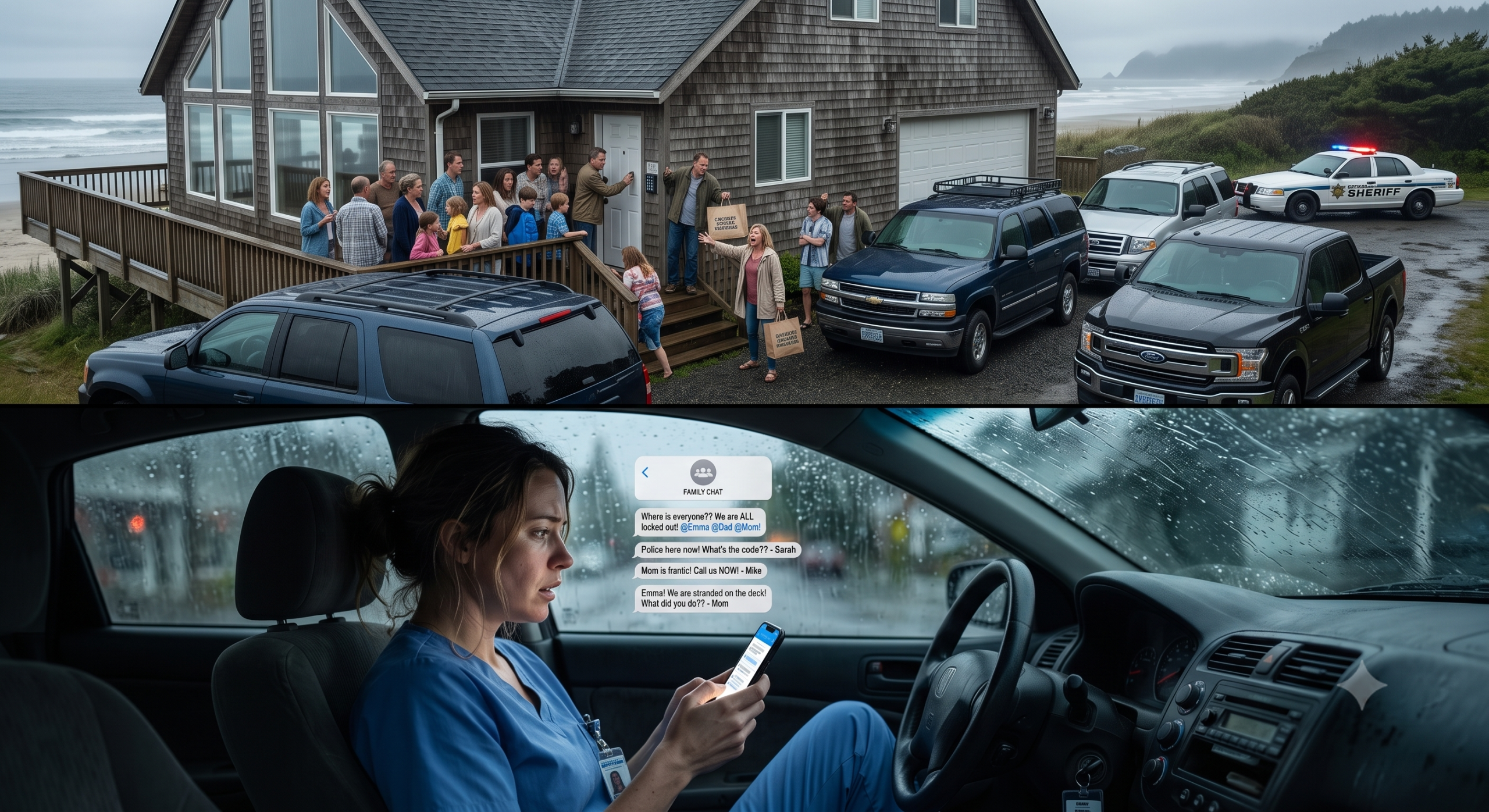
Cars.
SUVs.
Pickup trucks.
Children.
Coolers.
Beach chairs.
Suitcases.
Groceries.
At least twenty people.
Exactly as promised.
Mom stood near the front steps wearing oversized sunglasses and carrying two grocery bags.
Dad was trying the keypad.
Again.
And again.
And again.
Kyle stood beside him laughing.
Then Dad pulled out a key.
An old key.
One I recognized immediately.
The spare key he had copied without telling me.
He inserted it.
Turned.
Nothing happened.
Tried again.
Nothing.
Mom threw her hands into the air.
“What is wrong with this door?”
Kyle shrugged.
“Maybe Emma forgot.”
Dad slammed his hand against the frame.
“No.”
He looked furious.
Then my phone rang.
Dad.
I answered.
“What?” I said.
His voice exploded through the speaker.
“What did you do?”
“Good morning.”
“Don’t good morning me.”
“I just woke up.”
“We’re outside!”
“I noticed.”
“The keys don’t work.”
“Correct.”
“The garage won’t open.”
“Also correct.”
“Emma!”
I leaned back against my pillows.
“You should leave.”
His breathing became heavier.
“Everyone drove three hours.”
“That sounds unfortunate.”
“Your mother bought groceries.”
“Then your mother should return them.”
Mom’s voice shouted in the background.
“Tell her she’s acting ridiculous!”
I looked at the camera feed.
Children were sitting on coolers.
Cousins whispered to one another.
Aunt Cheryl looked confused.
Uncle Mark kept checking his phone.
Dad lowered his voice.
“Open the house.”
“No.”
“This is family.”
“This is trespassing.”
Silence.
Brief.
Sharp.
Dangerous.
Then Dad laughed.
But there was no humor in it.
“You wouldn’t actually call the police.”
I glanced at another notification.
Motion detected.
Driveway entrance.
A vehicle was approaching.
White.
Official.
County markings.
My eyes narrowed.
Mrs. Whitmore had apparently taken her responsibilities very seriously.
Because a sheriff’s cruiser was slowly pulling into the driveway.
And judging by the expression suddenly appearing on my father’s face—
He saw it too.
END OF PART 1
## PART 2
Dad noticed the cruiser at exactly the same moment I did.
On camera, his expression changed instantly.
The anger remained.
But now something else appeared beneath it.
Uncertainty.
He stepped away from the front door and straightened his jacket as though posture alone could make him look reasonable.
Kyle adjusted his baseball cap.
Mom lowered her sunglasses and squinted toward the driveway.
Several relatives turned around.
Children stopped running.
Even Aunt Cheryl set down the tray of sandwiches she had been carrying.
The cruiser rolled to a stop.
A deputy stepped out.
Tall.
Calm.
Middle-aged.
Professional in the way people become after spending years dealing with other people’s bad decisions.
He removed his sunglasses.
Looked at the crowd.
Looked at the house.
Then looked at my father.
“Morning,” he said.
Dad forced a smile.
“Officer.”
“Deputy.”
“Right. Deputy.”
“What seems to be going on?”
Dad gestured toward the house.
“Our daughter is overreacting.”
Mom nodded immediately.
“She’s a nurse. She works too much. She’s exhausted.”
I almost laughed.
Exhaustion.
That was their favorite explanation whenever I refused something.
Too tired.
Too stressed.
Too emotional.
Too sensitive.
Anything except right.
The deputy folded his arms.
“Who owns the property?”
Dad answered quickly.
“Our family does.”
I sat up straighter.
Interesting.
Because yesterday it had been my house.
Now it was family property.
The deputy glanced at his notepad.
“I have a different name listed here.”
Dad’s jaw tightened.
Mom stepped forward.
“Our daughter Emma owns it technically.”
Technically.
I bought the house.
I paid the mortgage.
I paid the taxes.
I paid for repairs.
Apparently ownership became technical when parents wanted free vacations.
The deputy nodded slowly.
“And does Emma Carter know everyone is here?”
Dad smiled.
“Of course.”
“No,” I said.
Every head turned.
I had activated the speaker function through the security app.
My voice came through clearly from the camera mounted beside the front door.
Mom flinched.
Dad looked upward.
“Emma.”
“Deputy,” I said, “my name is Emma Carter. I am the owner of this property.”
The deputy looked directly at the camera.
“Ms. Carter.”
“None of these people have permission to enter.”
Silence settled over the porch.
Kyle shifted uncomfortably.
Aunt Cheryl frowned.
Uncle Mark looked at Dad.
Mom recovered first.
“Oh honestly.”
She moved closer to the camera.
“Emma, enough.”
“I’m serious.”
“People took time off work.”
“I didn’t ask them to.”
“We already planned everything.”
“You planned everything.”
Dad rubbed his forehead.
“We’re standing outside like idiots.”
“That was avoidable.”
“Open the house.”
“No.”
Children had started asking questions.
“Grandma?”
“Why can’t we go inside?”
“Are we leaving?”
Mom smiled tightly.
“Everything is fine.”
The deputy raised a hand.
“Let’s slow down.”
He looked toward the camera.
“Ms. Carter, did you authorize anyone to access the property?”
“No.”
“Did you request law enforcement assistance?”
“I contacted the non-emergency line yesterday.”
He nodded.
“I have the report.”
Dad blinked.
“What report?”
“The one documenting unauthorized access concerns.”
Mom stared.
“You reported us?”
“I documented boundaries.”
Dad scoffed.
“Boundaries.”
“Yes.”
“We’re your family.”
“And this is my property.”
Dad threw his hands into the air.
“You see?”
He looked around dramatically.
“This is what happens when people spend too much time alone.”
Kyle laughed awkwardly.
No one joined him.
Because the mood was changing.
Confusion had begun replacing certainty.
Aunt Cheryl stepped forward.
“Wait.”
She looked at my mother.
“Linda.”
Mom smiled nervously.
“Yes?”
“Emma invited us, didn’t she?”
Mom hesitated.
Only for a second.
But long enough.
Long enough for people to notice.
“We assumed she wouldn’t mind.”
I spoke again.
“I specifically said no.”
Uncle Mark frowned.
“You said no?”
“Immediately.”
Mom crossed her arms.
“You’ve changed.”
No.
I thought.
I had simply stopped negotiating with people who never accepted answers they didn’t like.
The deputy glanced at the crowd.
“Folks, this appears straightforward.”
Dad interrupted.
“It’s a misunderstanding.”
“No.”
“It’s a family issue.”
“No.”
“It’s private.”
The deputy looked directly at him.
“Not when twenty people arrive at private property without permission.”
Kyle suddenly looked uncomfortable.
Very uncomfortable.
He glanced around.
Cousins avoided eye contact.
Aunt Cheryl looked embarrassed.
One of the Johnsons whispered something to his wife.
Mom turned toward the camera again.
“Emma.”
“What?”
“You’re humiliating us.”
For years, humiliation had been their weapon.
When I moved out at twenty.
Humiliation.
When I refused to cosign Kyle’s truck loan.
Humiliation.
When I skipped Christmas because I had worked thirty hours in two days.
Humiliation.
But somehow, accountability always felt like humiliation to people who expected access without permission.
“I didn’t invite twenty people to someone else’s house,” I said.
“You did.”
Dad’s face reddened.
“That’s enough.”
“No.”
His voice hardened.
“Emma.”
I recognized that tone.
The one from childhood.
The one designed to end conversations.
The one that used volume as authority.
Except I wasn’t ten anymore.
I wasn’t sixteen.
I wasn’t twenty-two and desperate for approval.
I was thirty-three years old.
And exhausted.
Not exhausted from nursing.
Exhausted from carrying responsibility for people who called it love when it benefited them.
The deputy cleared his throat.
“Mr. Carter.”
Dad turned.
“You and your guests need to leave.”
Mom looked stunned.
“Leave?”
“Yes.”
“We’ve done nothing wrong.”
“The property owner disagrees.”
“We’re standing outside.”
“After being denied access.”
Dad took a step forward.
“I helped raise that girl.”
The deputy nodded politely.
“And?”
Dad seemed genuinely surprised.
“And?”
“That doesn’t grant property rights.”
Kyle rubbed his face.
Mom whispered.
“Oh my God.”
Aunt Cheryl finally spoke.
“Linda.”
Mom looked at her.
“Did Emma actually tell you no?”
Mom didn’t answer.
That was answer enough.
Several relatives exchanged glances.
Uncle Mark sighed.
“We drove four hours.”
The deputy nodded.
“And now you’ll drive four hours home.”
One cousin muttered.
“This is awkward.”
Another replied.
“Apparently we weren’t invited.”
Dad pointed toward the camera.
“You’re destroying this family.”
I looked at the screen.
At the people.
At the coolers.
At the bags.
At years of assumptions standing in my driveway.
“No,” I said quietly.
“I just stopped giving away pieces of myself because people expected them.”
Mom’s expression changed.
Not sadness.
Not guilt.
Something closer to disbelief.
As though she genuinely could not understand why years of access no longer guaranteed future access.
The deputy gave everyone ten minutes.
People began gathering belongings.
Children complained.
Adults apologized to one another.
Coolers were loaded back into trunks.
Beach chairs disappeared.
Suitcases returned to vehicles.
Across the road, Mrs. Whitmore appeared.
Pink gardening gloves.
Coffee mug.
Perfect timing.
She pretended to adjust flowerpots while observing every second.
She caught sight of the camera.
Raised her mug.
I laughed.
Just a little.
Dad noticed.
And somehow that seemed to make him angrier than anything else.
He called me.
I declined.
He called again.
Declined.
Again.
Declined.
Then Mom sent a message.
Mom: I hope you’re proud.
I answered immediately.
Me: I am.
Three dots appeared.
Vanished.
Appeared again.
Then another message arrived.
Mom: Fine.
Mom: If ownership means this much to you—
Mom: Maybe it’s time we discuss everything you’ve taken from this family.
I stared at the screen.
Taken.
Interesting word.
Because for thirty-three years, I had been the one giving.
Money.
Time.
Energy.
Forgiveness.
Patience.
Space.
Excuses.
And apparently even that had not been enough.
I looked back at the camera feed.
The driveway was nearly empty now.
Cars pulling away.
Relatives avoiding eye contact.
Dad standing beside Mom.
Furious.
Embarrassed.
Exposed.
For the first time in my life—
My family had encountered a boundary they couldn’t guilt, shame, or manipulate their way around.
And judging by my mother’s last message—
The real fight had only just begun.
**END OF PART 2**
## PART 3
I read Mom’s message three times.
Maybe it’s time we discuss everything you’ve taken from this family.
Taken.
The word sat heavily in my chest.
Because if there was one thing my parents excelled at, it was rewriting history.
Suddenly, the child who became independent too early was selfish.
The daughter who worked holidays was distant.
The person who paid for things became the person who owed things.
I had heard versions of it my entire life.
You owe your brother support.
You owe us appreciation.
You owe your father respect.
You owe me gratitude.
You owe family loyalty.
The list never ended.
And somehow, what I owed always outweighed what I gave.
At nineteen, I paid my own tuition.
At twenty-four, I covered two months of Kyle’s rent because Dad said he was struggling.
At twenty-seven, I helped pay for Mom’s dental implants because insurance only covered part of the procedure.
At thirty, I loaned my parents eight thousand dollars during what they called a temporary setback.
I never saw that money again.
I stopped asking about it after the fourth excuse.
Dad was waiting for a bonus.
Mom was expecting a refund.
Things were tight.
Family helps family.
Family helps family.
Until family says no.
Then suddenly family becomes selfish.
I put my phone down.
Made coffee.
Got dressed.
And drove to Cannon Beach.
Rain followed me most of the way.
Gray skies.
Wet roads.
The Pacific Ocean hidden beneath low clouds.
Normally, the drive calmed me.
That morning, it felt different.
Not sad.
Not angry.
Just clear.
Like finally putting on glasses after years of squinting.
When I arrived, everything looked exactly as I remembered.
Weathered cedar siding.
White railings.
Large windows facing the ocean.
A place built from sacrifice.
My sacrifice.
The front porch was clean except for a torn grocery bag, a crushed juice box, and a package of hamburger buns someone had abandoned near the steps.
Evidence.
Small.
Unimportant.
Yet somehow symbolic.
People had shown up expecting ownership.
Then left behind their inconvenience.
I picked everything up.
Disposed of it.
Unlocked the front door.
Walked inside.
Silence greeted me.
Warm.
Comfortable.
Mine.
I moved from room to room.
No damage.
No forced entry.
No broken windows.
No signs of tampering.
Only peace.
The kind peace that doesn’t need permission.
A knock sounded at the door.
Mrs. Whitmore stood outside carrying a casserole dish.
She smiled.
“You survived.”
“I think so.”
She handed it to me.
“Chicken pot pie.”
“You really don’t have to keep feeding me.”
She grinned.
“And you really don’t have to keep providing entertainment.”
I laughed.
“You watched everything?”
“Honey.”
She adjusted her glasses.
“I watched the whole thing from my kitchen window.”
“I’m afraid to ask.”
“Your father waved his arms around for at least twenty minutes.”
“Sounds accurate.”
“And your mother kept saying people would understand once they got inside.”
I shook my head.
“They never planned to ask.”
“No.”
Mrs. Whitmore said gently.
“They planned for you to surrender.”
That sentence followed me long after she left.
Because she was right.
People who depend on your kindness often mistake it for compliance.
And once they become accustomed to access—
Boundaries feel like betrayal.
My phone buzzed.
Cousin Sarah.
Sarah: Emma, I’m really sorry.
Another message arrived.
Uncle Mark.
Uncle Mark: We genuinely thought you invited everyone.
Then Aunt Cheryl.
Aunt Cheryl: Your mother told us it was your idea.
Interesting.
Within twenty-four hours, the story had begun collapsing.
Truth usually moved slowly.
But lies moved even slower once enough people started asking questions.
I opened the family chat.
Still active.
Still chaotic.
Kyle: This whole thing could have been handled privately.
Mom: Thank you.
Dad: Exactly.
Me: Twenty people standing outside my house wasn’t private.
Silence.
Then Kyle responded.
Kyle: You embarrassed Mom.
Me: Mom embarrassed herself.
Mom: Wow.
Mom: Thirty-three years of motherhood and this is what I get.
I closed my eyes.
There it was.
The invoice.
Every parent-child disagreement in our family eventually became a debt calculation.
We fed you.
We raised you.
We sacrificed.
As though love required reimbursement.
I typed carefully.
Me: Raising your child isn’t a favor.
No response.
For several minutes.
Then Dad called.
I answered.
“Hello.”
“You think you’re clever.”
“No.”
“You made us look ridiculous.”
“You arrived at someone else’s house without permission.”
“We’re family.”
“We’ve established that.”
“People are talking.”
“People should know the truth.”
His breathing became heavier.
“You’ve changed.”
I looked out toward the ocean.
Waves rolled steadily against the shore.
Constant.
Predictable.
Unaffected by guilt.
“I hope so.”
“What does that mean?”
“It means I stopped apologizing for protecting things I worked for.”
Dad scoffed.
“A house.”
“Not a house.”
“What then?”
“Years.”
Silence.
Because people who take rarely count what things cost.
Only what they gain.
“You know,” I said quietly, “I spent Christmas in the emergency department two years ago.”
“So?”
“So Kyle wanted a family vacation.”
Dad didn’t answer.
“You remember where that vacation happened?”
Silence.
“My beach house.”
“We’re your family.”
“You didn’t ask.”
“We didn’t think we had to.”
Exactly.
That was always the problem.
Not the house.
Not the keys.
Not even the vacation.
Expectation.
Access.
Entitlement disguised as closeness.
Dad sighed.
“You’ll regret this.”
“No.”
“You’ll need us someday.”
I almost smiled.
Because that assumption had survived every conversation.
That independence was temporary.
That eventually I would come back.
Need approval.
Need support.
Need permission.
But the truth was—
I hadn’t needed them in years.
Not financially.
Not emotionally.
Not practically.
What I had wanted was a healthy relationship.
And those are not the same thing.
“I’ll call you when you’re ready to apologize,” I said.
Then I ended the conversation.
For the first time in my life.
Without guilt.
Without explaining.
Without softening my words.
Just done.
A week passed.
Then two.
The family chat became quieter.
Less certainty.
More questions.
Apparently people had started comparing stories.
Apparently relatives discovered they had received different versions.
Apparently my mother had promised everyone there would be a seafood dinner.
Apparently my father had implied he helped pay for the beach house.
He had not.
Not one dollar.
One afternoon, Sarah called.
“Can I ask something?”
“Sure.”
“Did your dad really contribute financially?”
“No.”
“At all?”
“No.”
“Oh.”
“Why?”
“Because Uncle Mark said your father claimed he covered the down payment.”
I laughed.
Not because it was funny.
Because it was absurd.
“My down payment came from six years of overtime.”
“Oh.”
“I still have the bank records.”
Sarah paused.
“I don’t think everyone realized.”
“They do now.”
Autumn arrived.
Tourists disappeared.
The coastline became quieter.
I spent more weekends at the beach house.
Sometimes alone.
Sometimes reading.
Sometimes sleeping twelve uninterrupted hours.
Sometimes doing absolutely nothing.
And for someone who spent years believing rest had to be earned—
Doing nothing felt revolutionary.
Kyle texted in October.
Kyle: Can we talk?
I almost ignored it.
Almost.
But curiosity won.
We met for coffee.
He looked uncomfortable.
Older somehow.
Less certain.
“I owe you an apology,” he said.
I waited.
“I laughed.”
“Yes.”
“I shouldn’t have.”
“No.”
“I honestly thought you’d give in.”
“I know.”
“Mom always said you eventually do.”
That hurt.
Not because it was cruel.
Because it was true.
For years, I had eventually given in.
Loans.
Holidays.
Access.
Compromises.
Energy.
Until there was very little left.
Kyle stirred his coffee.
“Dad lied about some things.”
“I know.”
“He told me he paid my rent when I was twenty-five.”
“He didn’t.”
“You did.”
“Yes.”
Kyle nodded slowly.
“He never told me.”
“No.”
“I’m sorry.”
For once—
It sounded genuine.
Not perfect.
Not enough to erase history.
But honest.
And honesty mattered.
Even late.
Especially late.
Winter arrived.
Then Thanksgiving.
Family gathered at Aunt Cheryl’s house.
I considered not going.
Then Sarah convinced me.
“Come for the people who respect you.”
So I went.
Mom hugged relatives.
Dad watched football.
Kyle helped in the kitchen.
People greeted me differently now.
Carefully.
Respectfully.
As though boundaries had taught them something.
Dinner was awkward.
But survivable.
At one point, Mom found me alone on the porch.
Cold air surrounded us.
“You really are different,” she said.
“Yes.”
“I don’t know where this came from.”
I looked at her.
Really looked.
For years, I had seen my mother as enormous.
Emotionally powerful.
Impossible to disappoint.
Now she looked smaller.
Not weak.
Human.
A woman accustomed to getting her way.
Confused by resistance.
“It came from being tired,” I said.
“Tired?”
“Tired of earning things twice.”
She frowned.
“What does that mean?”
“It means I already paid for the beach house.”
I paused.
“I shouldn’t have to pay for it again with guilt.”
Mom looked away.
For a moment—
Just a moment—
She seemed sad.
Not manipulative.
Not dramatic.
Simply sad.
Maybe because she understood.
Maybe because she didn’t.
I never asked.
Some people apologize.
Others simply lose access.
And that becomes the apology.
By spring, life felt different.
Quieter.
Healthier.
Kyle visited the beach house once.
He asked permission.
Two weeks ahead of time.
Brought groceries.
Washed dishes.
Left a thank-you note.
Mom and Dad never came.
Not because I hated them.
Not because I wanted revenge.
Because ownership mattered.
Consent mattered.
Respect mattered.
And love without respect eventually becomes obligation.
One morning, almost a year after the attempted beach weekend, I stood on the deck with a cup of coffee.
The ocean stretched endlessly before me.
Gray.
Beautiful.
Calm.
My phone buzzed.
Dad.
A message.
Dad: Your mother was wondering if maybe we could visit sometime.
I read it twice.
No apology.
No acknowledgment.
No accountability.
Just a request.
The same pattern.
A little softer.
But still familiar.
I typed carefully.
Me: You’re welcome to ask me directly when you’re ready to acknowledge what happened.
Three dots appeared.
Disappeared.
Appeared again.
Then vanished completely.
No answer came.
And that was okay.
Because for most of my life—
Silence had felt like punishment.
Like rejection.
Like proof I had done something wrong.
Standing there with the ocean in front of me and my coffee growing cold in my hands—
Silence felt different.
It felt earned.
It felt safe.
For the first time in years—
My beach house wasn’t a family gathering place.
It wasn’t an obligation.
It wasn’t a symbol.
It wasn’t something to defend.
It was simply mine.
And that morning—
That was enough.
**THE END**